SEVILLE’S JEWISH QUARTER: HISTORY, HIDDEN STORIES AND WHAT YOU CAN STILL SEE TODAY

Walk through Seville’s Santa Cruz neighbourhood today and it is easy to understand why it has become one of the most photographed parts of the city. Narrow streets wind between whitewashed houses, small squares appear unexpectedly around corners, and orange trees provide shade beside fountains and tiled façades. It is one of those parts of Seville where getting slightly lost is usually more enjoyable than following a map.
Yet there is a problem with the way Santa Cruz is sometimes presented to visitors. The neighbourhood you see today is not a perfectly preserved medieval Jewish Quarter, nor does everything that looks old date from the period when a Jewish community lived here. Buildings have been rebuilt, streets and squares have changed, and later generations have added their own stories and legends to the neighbourhood. Some of the places that now seem quintessentially “old Seville” owe part of their appearance to transformations carried out centuries later.
That does not make the Jewish history of this part of Seville any less important. Quite the opposite. For centuries, the city was home to a significant Jewish community whose history became intertwined with that of medieval Seville. To understand what happened here, however, we need to look beyond the picturesque streets and distinguish between what survives, what has changed and what has become part of the city’s collective memory.
So rather than approaching Santa Cruz as a checklist of supposedly Jewish monuments, there is a more interesting way to explore it: Where exactly was Seville’s Jewish Quarter? Who lived there? What happened to the community, and what can we genuinely still see today?

Where Was Seville’s Jewish Quarter?
The area described today as Seville’s Jewish Quarter is usually associated with Santa Cruz, immediately beside the Royal Alcázar and only a few minutes from the Cathedral. Historically, however, its geography was more extensive than the neighbourhood most visitors identify as Santa Cruz today. The former Jewish area also included present-day Santa María la Blanca and San Bartolomé, forming a substantial district within the eastern section of the walled city. This wider geography is easy to overlook when exploring modern Seville, where the boundaries between these areas are far less obvious.
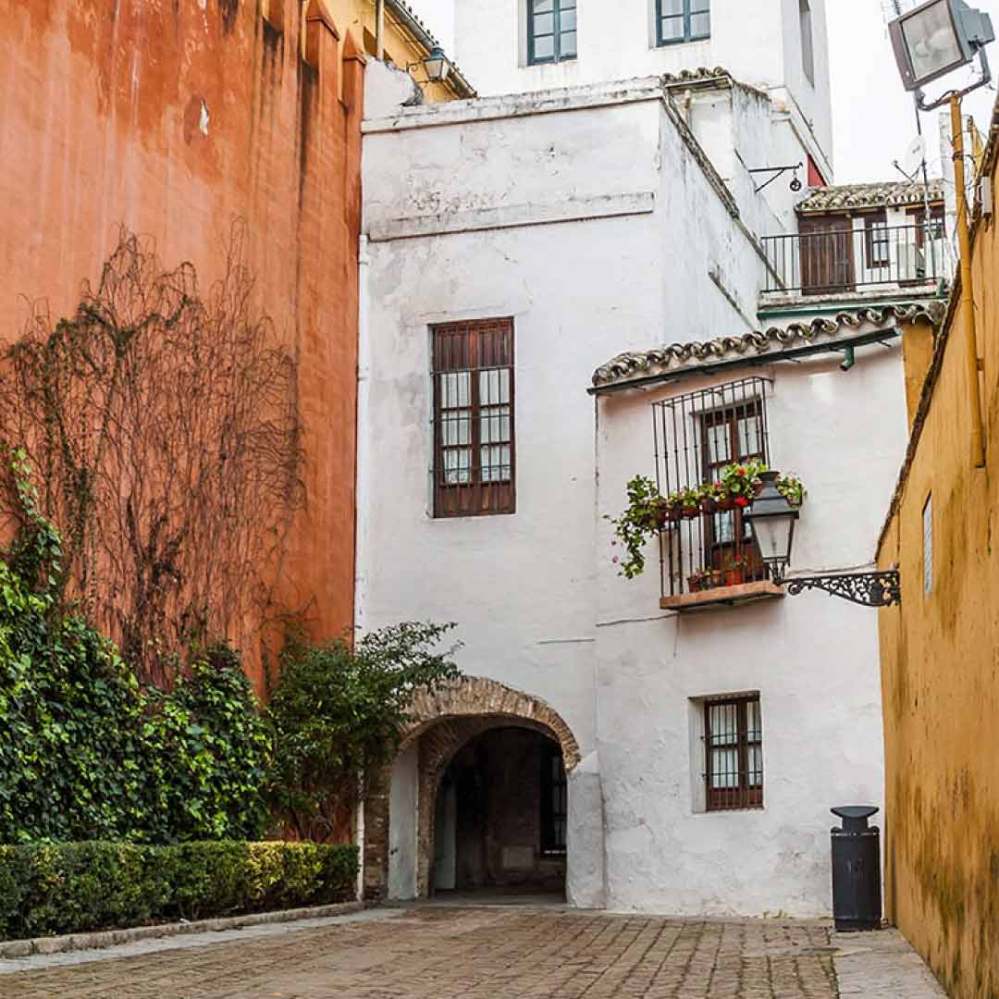
You can still get a sense of that geography on foot. Entering from Plaza del Triunfo through Patio de Banderas towards Calle Judería, the monumental openness around the Cathedral and Alcázar quickly gives way to a much tighter network of streets. Continue towards Calle Vida or follow Callejón del Agua beside the Alcázar walls and the relationship between the neighbourhood and the medieval city becomes easier to read. The walls, changes in street width and sudden transitions between open and enclosed spaces often tell you as much about the development of the area as individual monuments do.
The Jewish community had its own religious and communal spaces, but it should not be imagined as a world completely disconnected from the rest of Seville. Its inhabitants formed part of the wider life of the medieval city, and the history of the Jewish Quarter therefore belongs to the history of Seville itself. This is an important distinction, because treating the area simply as an isolated enclave makes it much harder to understand both its importance and what happened to it later.
A Jewish Community at the Heart of Medieval Seville
The Jewish presence in Seville predates the Christian conquest of the city, but a new period began after Ferdinand III of Castile took Seville in 1248. Under Christian rule, the Jewish community occupied a defined area of the city, and during the 13th and 14th centuries it played an important role in Seville. As elsewhere in medieval Iberia, however, periods of coexistence were accompanied by restrictions, tensions and episodes of hostility. The reality was considerably more complicated than either the romantic idea of uninterrupted harmony between three cultures or the opposite image of communities living entirely separate lives.
Walking through Santa Cruz today, it is tempting to imagine that its narrow streets provide a direct window into that medieval world. Some elements of the urban layout certainly help us understand how the neighbourhood developed, but the city around them has changed enormously. Buildings have disappeared or been rebuilt, uses have changed and later urban interventions have reshaped parts of the neighbourhood. What looks medieval is not necessarily medieval, and that distinction will become important as we explore some of Santa Cruz’s best-known squares and streets later in this article.
For that reason, one of the best ways to understand the former Jewish Quarter is not to search for a perfectly preserved medieval neighbourhood, but to learn how to read the different historical layers that remain. A wall may help us understand where one space ended and another began; a former religious building can reveal how the neighbourhood changed after the Jewish community disappeared; and archaeological discoveries in apparently ordinary parts of modern Seville can sometimes tell us more about its medieval past than its most photographed squares.
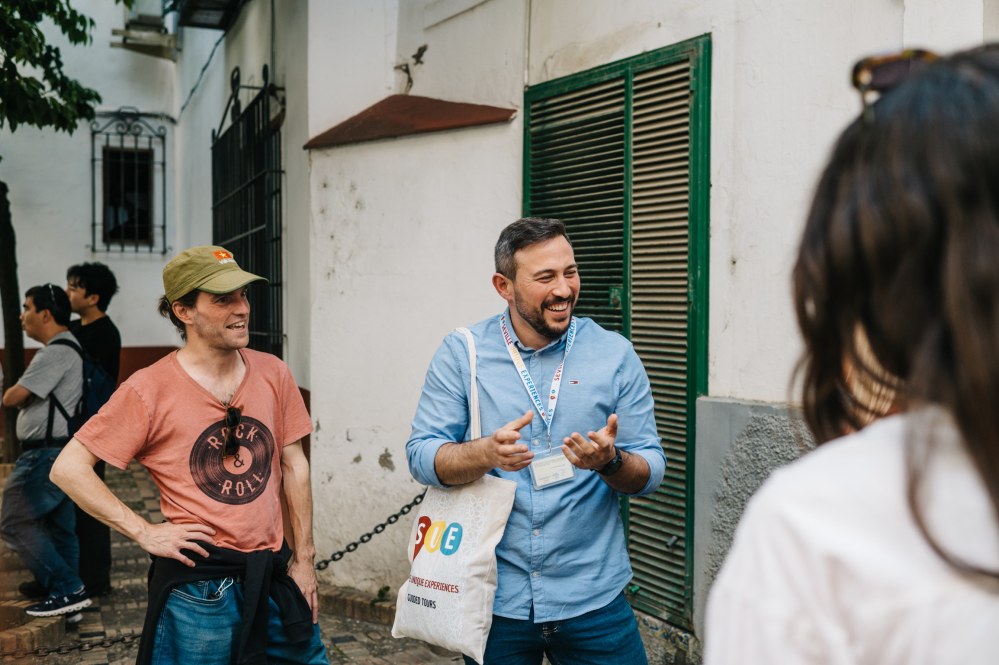
If you want to explore these layers in greater depth, our Seville Jewish Quarter Discovery Walk follows this part of the city in a small group of no more than 10 guests, using its streets, walls and surviving traces to understand how the neighbourhood developed and changed over time.
1391: The Year That Changed Jewish Seville
For Seville’s Jewish community, 1391 marked a decisive turning point. Anti-Jewish hostility had been growing during the previous decades, encouraged in Seville by the preaching of Ferrán Martínez, Archdeacon of Écija. In June 1391, the Jewish Quarter was attacked in an outbreak of violence that would soon spread to other cities across the Iberian Peninsula. People were killed, homes were abandoned and many members of the community faced a choice between fleeing and converting to Christianity. Historians continue to debate the scale of the violence itself, but there is little doubt about the magnitude of its consequences: the Jewish community that emerged afterwards was profoundly different from the one that had existed before.
This is why it can be misleading to tell the history of Jewish Seville as a simple journey from medieval coexistence to the expulsion of 1492. More than a century separates 1391 from the expulsion, and during those decades Seville developed a substantial population of conversos: people of Jewish origin who had converted to Christianity, sometimes voluntarily and sometimes under intense social or political pressure. The distinction between Jews and converts would become increasingly important during the 15th century, particularly as suspicions arose that some New Christians continued to practise elements of Judaism in private.
Those tensions help explain why Seville would play such an important role in the early history of the Holy Inquisition. The new tribunal was authorised by Pope Sixtus IV at the request of the Catholic Monarchs in 1478, and Seville became the first city in which it began operating. Its attention was initially directed primarily towards converts suspected of secretly maintaining Jewish practices, rather than towards practising Jews themselves. The establishment of the Inquisition therefore belongs to the complicated history created in the decades after 1391, when conversion had changed the religious and social landscape of the city.
Susona: Between History and Legend
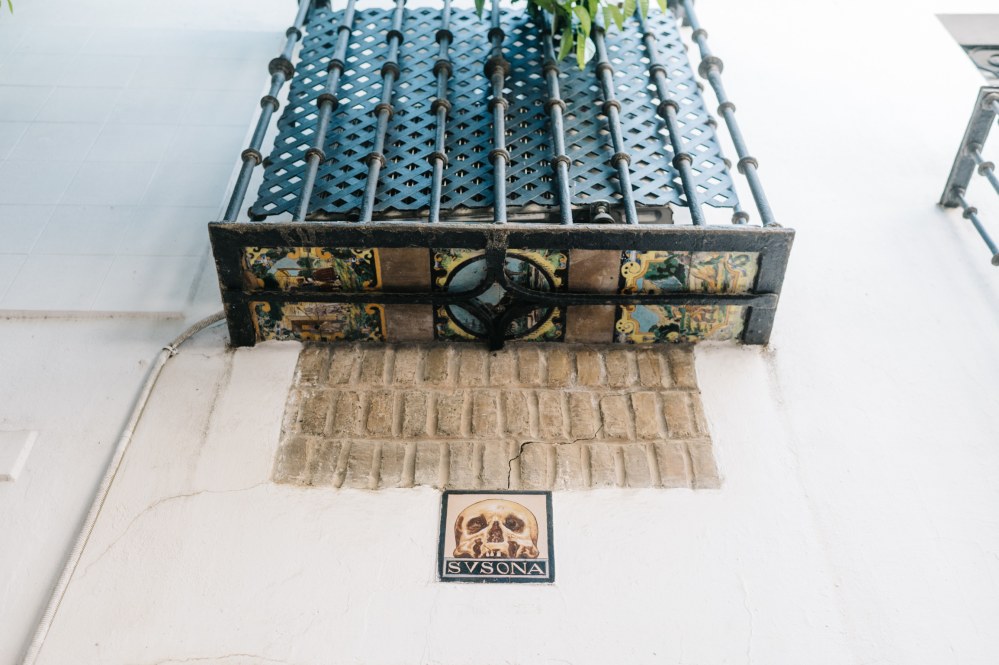
One of the best-known stories associated with this period is the legend of Susona, whose name still appears on a small street in Santa Cruz. According to the traditional story, Susona was the daughter of a wealthy converso involved in a conspiracy against the authorities. She supposedly revealed the plot to her Christian lover, leading to the arrest and execution of her father and the other conspirators. Later versions of the tale add an even darker ending, claiming that after her death her skull was displayed outside her former home as a warning and an expression of repentance.
It is a compelling story, but it is important to recognise it for what it is: a legend in which historical events and later storytelling have become intertwined. The tensions affecting Seville’s converso population and the persecution that followed the establishment of the Inquisition are historical realities; the familiar details of Susona’s life are much harder to document. Rather than presenting every element as fact, the story is more interesting as an example of how Seville has remembered and retold this turbulent period over the centuries. This is also how we approach Susona during our Jewish Quarter walk: legends can help us understand a city, as long as we distinguish them from documented history.
1492 and the Sephardic Diaspora
By the time the Catholic Monarchs issued the Edict of Expulsion in 1492, Jewish life in Seville had already been profoundly transformed. The decree required practising Jews in the kingdoms of Castile and Aragon to convert to Christianity or leave, but in Seville the process of displacement had begun even earlier: measures introduced in 1483 had already ordered Jews to leave Seville, Córdoba and Cádiz. The events of 1492 should therefore be understood not as an isolated moment, but as the culmination of a much longer process of increasing pressure, conversion and exclusion.
For those who left the Iberian Peninsula, however, departure did not mean the disappearance of their culture. Sephardic communities developed across the Mediterranean, North Africa and other parts of Europe, preserving traditions and memories connected with Sefarad, the Hebrew name traditionally associated with the Iberian Peninsula. One of the most remarkable legacies was Judeo-Spanish, or Ladino, which retained a strong Iberian linguistic base while evolving through centuries of contact with other languages. The physical Jewish Quarter of medieval Seville was disappearing, but parts of its cultural memory would survive far beyond Spain.
What Can You Still See in Seville’s Jewish Quarter Today?
Unlike other historic areas where a single monument dominates the story, Seville’s former Jewish Quarter has to be discovered through fragments. No medieval synagogue survives intact as a synagogue, and much of the neighbourhood has been transformed over the centuries. What remains is a combination of street patterns, former religious sites, archaeological discoveries and the physical relationship between the quarter and the walls that once defined the city. This is precisely what makes exploring the area so interesting: understanding Jewish Seville requires learning to recognise traces that are not always obvious at first sight.
The Alcázar Walls and the Streets of Santa Cruz
Some of the easiest traces to understand are found around Calle Judería, Calle Vida and Callejón del Agua. Here, the walls of the Royal Alcázar provide a physical reference point that helps us reconstruct the geography of the medieval neighbourhood. The narrow streets and sudden changes of direction contribute to the distinctive character of Santa Cruz today, although, as we have already seen, we should be cautious about assuming that every building or picturesque corner has survived unchanged from the Middle Ages.
This is also one of the pleasures of exploring the area on foot. Within a relatively short distance, you can move from the monumental surroundings of the Cathedral and Alcázar into streets that feel completely different in scale. Rather than rushing through them on the way to the next attraction, take some time to notice how the neighbourhood fits against the walls and how quickly its urban character changes.
A Jewish Cemetery Beneath Modern Seville
One of the most fascinating traces of the Jewish community lies beyond the streets most visitors associate with Santa Cruz. The medieval Jewish cemetery was located outside the city walls, in an area connected with the present-day Jardines de Murillo and Cano y Cueto. Archaeological discoveries made here have provided physical evidence of the necropolis and remind us that the geography of medieval Seville was very different from the city we walk through today.
The location makes much more sense when you understand the former city limits. Leaving Santa Cruz towards the Jardines de Murillo means crossing a boundary that has largely disappeared from the modern landscape: in medieval Seville, you would have been moving from the inhabited city towards an area outside its walls. Today, cars pass through Cano y Cueto and visitors walk through the gardens without necessarily realising that part of the history of Jewish Seville survives beneath this modern urban landscape.
Santa María la Blanca: Layers of Religious History
Continue towards San Bartolomé and you reach one of the most important places for understanding the religious history of the former Jewish Quarter: Santa María la Blanca. The site reflects several layers of Seville’s past. A mosque existed here during the Islamic period; after the Christian conquest, the building became one of the synagogues associated with the Jewish community; and following the violence of 1391 it was converted into a Christian church. The building visitors encounter today, however, owes much of its appearance to later transformations and should not be imagined as a medieval synagogue preserved behind a Christian façade.
That succession — mosque, synagogue and church — makes Santa María la Blanca particularly valuable for understanding how religious spaces changed as political and religious power shifted in Seville. Its spectacular Baroque interior belongs to a much later period, but knowing what previously occupied this site adds another dimension to a visit. It is a good example of something that happens repeatedly in Seville: the same location can contain the histories of several very different cities.
A Mikveh Hidden Beneath the Neighbourhood
Just opposite Santa María la Blanca is another, much less obvious reminder of the religious history of the area. In the basement of Casa Mikva, a restaurant located in the heart of the former Jewish Quarter, there is a historic bathing space associated with a mikveh, the ritual bath used in Judaism for purification. The site has also been linked to an earlier hammam from the period when a mosque occupied the site of present-day Santa María la Blanca, adding another layer to the remarkable religious history of this small corner of Seville.
Casa Mikva is first and foremost a restaurant rather than a conventional historical attraction, so access to the mikveh should not be taken for granted. During our walks, we only visit the space when the restaurant is not busy and the staff give us permission; otherwise, we explain its history from outside. Whether you see the interior or not, its presence is a fascinating reminder that some of the most interesting traces of Jewish Seville are hidden beneath buildings that now serve completely different purposes.
The Jewish Quarter You See Today
One of the most interesting things about exploring Santa Cruz is realising that the neighbourhood itself has continued to evolve long after its Jewish community disappeared. Houses were rebuilt, streets changed and public spaces acquired new functions and appearances over the centuries. Some of the transformations that most influence what visitors see today took place much later, particularly during the urban improvements associated with Seville’s preparations for the Ibero-American Exposition of 1929. This is why a picturesque square or narrow street should not automatically be interpreted as an untouched piece of medieval Seville.
Plaza de Doña Elvira is a good example. Today it seems almost inseparable from the romantic image of Santa Cruz, with its orange trees, fountain, tiled benches and traditional houses, yet the square in its present form is largely the result of early 20th-century urban planning. Knowing this does not make the neighbourhood any less appealing. On the contrary, it allows us to see Santa Cruz for what it really is: a place where medieval traces, later architecture, literature, legend and modern Seville have gradually become intertwined.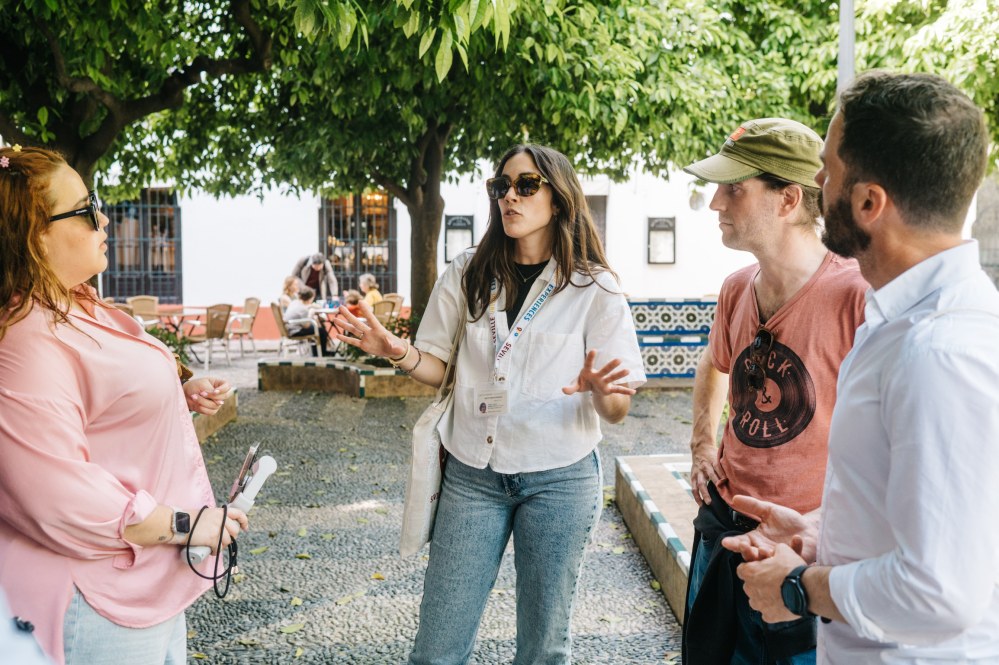
The Best Way to Explore Seville’s Jewish Quarter
The former Jewish Quarter is a relatively small area, so there is no need to rush through it. In fact, it is one of those parts of Seville that rewards exactly the opposite approach. Walk beyond the busiest streets, pay attention to the walls and changes in the urban layout, and allow yourself time to understand how Santa Cruz connects with Santa María la Blanca and San Bartolomé. This slower way of discovering the city is closely connected to what we mean by Slow Travel in Seville: seeing fewer places with greater context rather than simply moving from one attraction to another.
This is particularly relevant in the Jewish Quarter because many of its most important stories are not immediately visible. There is no single monument capable of explaining the neighbourhood, and some of its most revealing traces can easily be missed without knowing where to look. The walls of the Alcázar, the location of the former cemetery, the religious transformations of Santa María la Blanca and even the legends attached to its streets all become pieces of a much larger story.
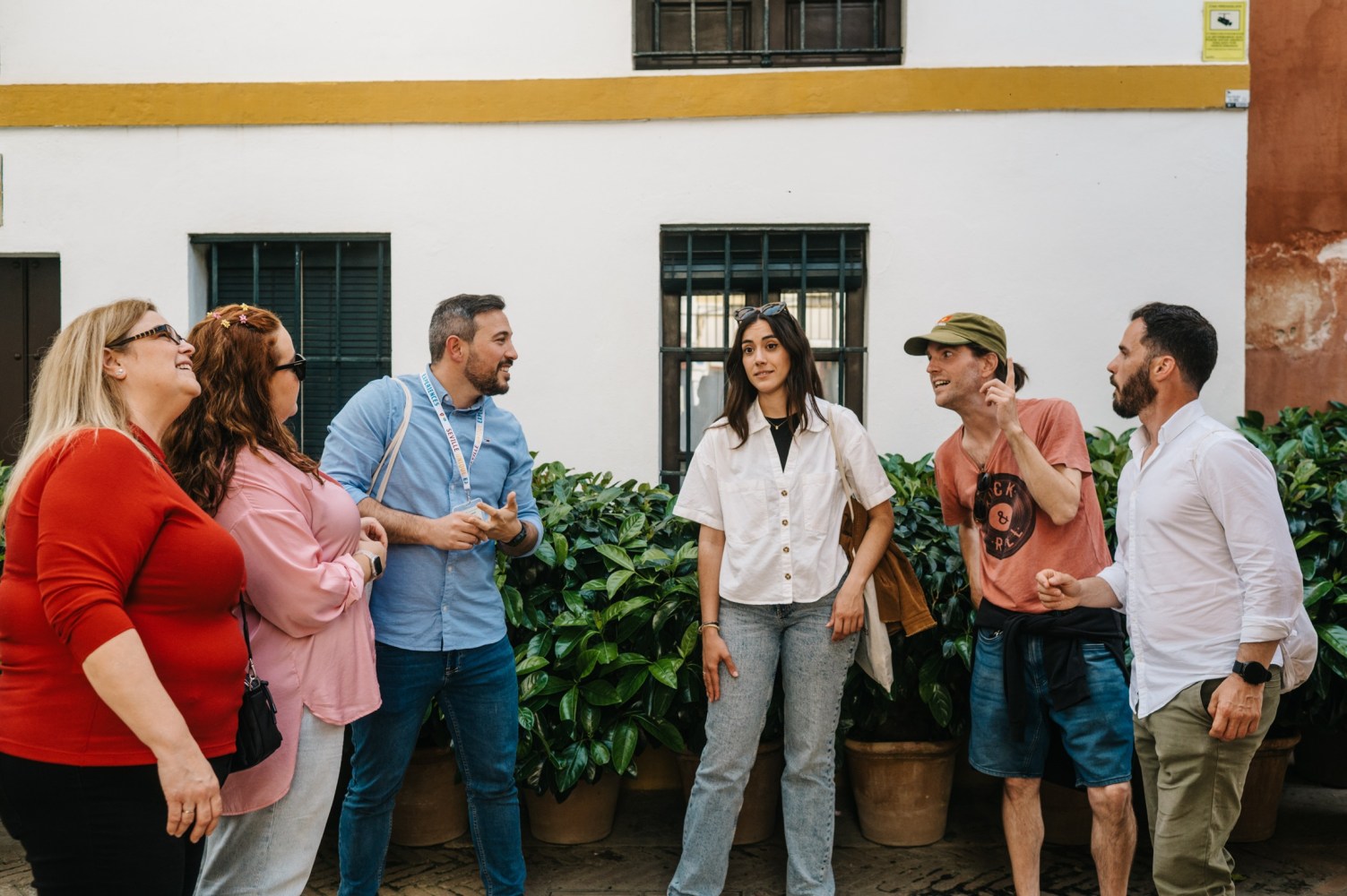
If you would like to explore that story with us, our Seville Jewish Quarter Discovery Walk follows the former Jewish neighbourhood in a small group of no more than 10 guests. Over approximately 90 minutes, we use the streets and surviving traces of Santa Cruz and its surroundings to explore medieval Jewish Seville, the events of 1391, the Inquisition, the Sephardic diaspora and the mixture of history and legend that still shapes the neighbourhood today. Rather than simply showing you where to go, our aim is to help you understand what you are looking at.